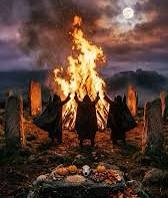
The Winter Witch rules half of the year from Sanhain; she controls storms, frost and cold weather. According to legend, she is said to have shaped Ireland’s countryside with her magic.
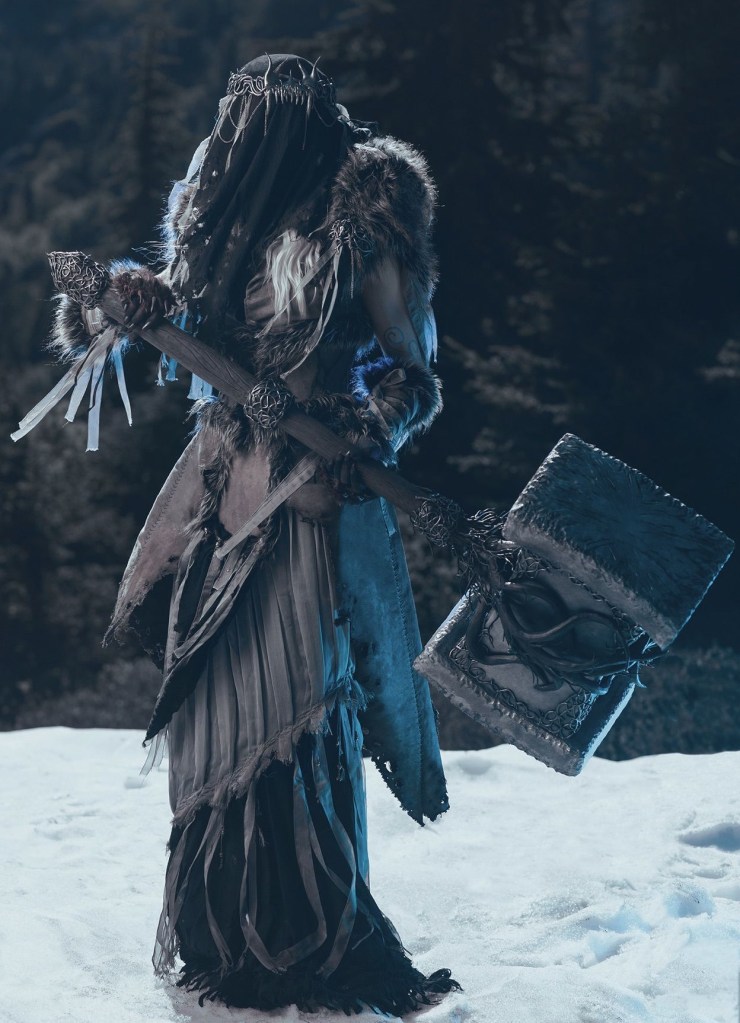
The story of An Chailleach (pronounced on khol-yokh) is deeply woven into the landscape, language, and ancient seasonal rituals of Ireland. In Irish mythology, she is not merely a winter witch, but a sovereign creator deity, a shaper of the landscape, and is also the personification of winter itself. In Irish folklore An Chailleach is credited with building the mountains and hills of Ireland.
The Sieve of Boulders
The wicker basket (or creel) mentioned in stories comes directly from legends explaining Ireland’s unique rock formations. It was believed that as An Chailleach strode across the land, boulders tumbled out of her basket, forming prominent megalithic sites. Also mentioned are the Carrowkeel Passages. The passage tombs at Carrowkeel and the Sliabh na Caillí (The Hill of the Witch) at Loughcrew in County Meath are traditionally said to be the cairns she dropped while jumping from peak to peak.
The Turning of the Seasons Samhain and Imbolc are important seasons in the Irish calendar. The Calendar was entirely dictated by the pastoral and agricultural year, divided cleanly between the dark half and the light half.
Samhain occurs on the 1st November and this festival marked the official beginning of winter. According to Irish tradition, this is the exact night An Chailleach returns from her summer slumber. She strikes the ground with her staff, freezing the grass and bringing the dark months.
Imbolc
This season begins on the 1st February and the winter witch’s reign ends at Imbolc, the festival marking the arrival of spring. Irish folklore states that if the weather on Imbolc is bright and sunny, it means An Chailleach is gathering more firewood to keep the winter going longer. If it is a raging storm, she is sleeping, meaning spring will arrive early.
The Protector of Wild Animals
Unlike the modern, villainised trope of a witch, the ancient Irish viewed An Chailleach with immense respect. She was the Cailleach Bhéara (The Hag of Béara), associated heavily with the Beara Peninsula in County Cork. She was worshipped as the ultimate guardian of the wilderness and was the protector of deer, goats, and wolves during the harsh winter months when resources were scarce. Hunters, like Tadhg in the legends, had to respect her laws; taking too much game or disrespecting the seasonal boundaries would incur her wrath.
The Blue-Skinned Ancestor
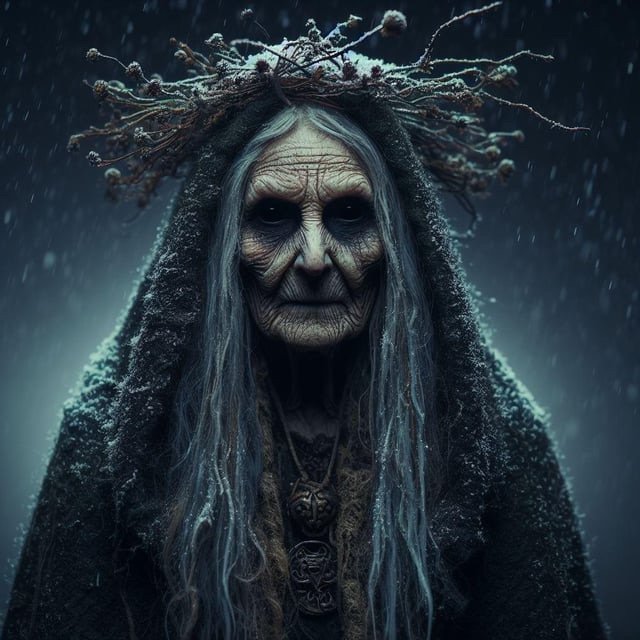
In the oldest Irish texts, such as the 9th-century poem, The Lament of the Old Woman of Beare, she is described as having a deep blue-grey complexion (glassin in Old Irish). This colour did not signify evil, but rather the deep frost of winter, ice, and her connection to the ancient, timeless rocks of the earth. She represents the necessary cycle of death and decay that allows the soil to rest before spring
A Short Tale of An Chailleach
The air over the hills turned the colour of bruised iron. An Chailleach, the ancient winter witch and veiled crone of the Celts, was waking.For months, she had slumbered as a grey, weathered stone beneath the wild gorse, letting the golden youth of summer warm the earth. But the wheel of the year had turned to Samhain. Her skin, once soft, hardened into the deep, frost-bitten blue of a glacial crevasse. Her silver hair tangled like frozen briars, and her single, piercing eye opened to stare down at the valleys. She stood up straight and tall, a giantess shifting the very foundations of the earth. On her back, she slung her heavy creel—a wicker basket filled with jagged boulders.”Too soft,” she muttered, her voice like grinding tectonic plates. “The land has grown soft and lazy under the sun.”
With her heavy stone hammer in hand, she strode across the peaks. As she walked, her great woollen plaid dragged behind her. She reached the roaring ocean gulf where the great whirlpool churned and for three days and nights, she fought the waves, washing her dark cloak in the freezing waters until it was bleached a pure, brilliant white. When she pulled it from the surf and threw it across the Highlands, the first blinding blizzard of the year dazzling the earth. As she marched inland to herd her beloved deer, a young hunter named Tadhg stood frozen in a valley. He had tracked a stag far into the high country, ignoring the elders’ warnings that the Queen of Winter was reclaiming her throne. The wind screamed a warning to him and a dense mist cloaked the glens. Suddenly, the storm parted, and standing before Tadhg was An Chailleach, towering over the pines. Tadhg immediately fell to his knees and his breath caught in his throat. He expected to be hit by the cruel strike of her winter hammer, but the old witch looked down at the shivering mortal and her stern face softened slightly. She struck her magical ice staff against the ground and instantly the roaring gale subsided into a quiet, breathless snowfall.
“You look for death in the cold, little mortal,” she said, her voice echoing down the glen. “But winter is not the enemy of life. It is the cradle.” She reached into her wicker basket and tossed a small, heavy stone at his feet. Where the stone struck the frozen dirt, a deep valley tore open, shielding him from the worst of the wind.
“Go back to your hearth,” she commanded, turning her back to guide her deer up the snowy slopes.
“Sleep – gather your strength, and respect the quiet dark. Nature must sleep before it can build anew.” Tadhg scrambled back to his village, alive to tell the tale. And for the rest of that bitter season, whenever the wind whistled through the rafters, the villagers didn’t cower in fear of an evil witch. They knew it was simply An Chailleach, carving the world with her hammer, wrapping the earth in her protective blanket of snow, and keeping watch over the wild land until the youth of spring was ready to return.


Leave a Reply